

"Deep Learning" is Social Emotional Learning (SEL) on steroids...
All-Encompassing Framework Transforming kids through Education

Emotional Engineering in K-12 Classrooms
Start Here: The following two video clips are from The 2025 MIT Systems Awareness Lab Conference.
This first video is Mary Helen-Immordino-Yang / USC Center for Affective Neuroscience and Developmental Learning and Education (CANDEL). Yang is working on ways to integrate Transcendent Thinking (Deep Learning) into the k-12 classrooms. Recently, she trained 17 teachers in the Anaheim Union High School District, CA. (AUHSD). See the clip below or see Full Video here
In this next video we see Michael Fullan, NPDL responding to Mary Helen-Immordino-Yangs’ experiments on children. I know it’s hard to imagen that “this guy” is a world leader in education systems
You can watch the full video here
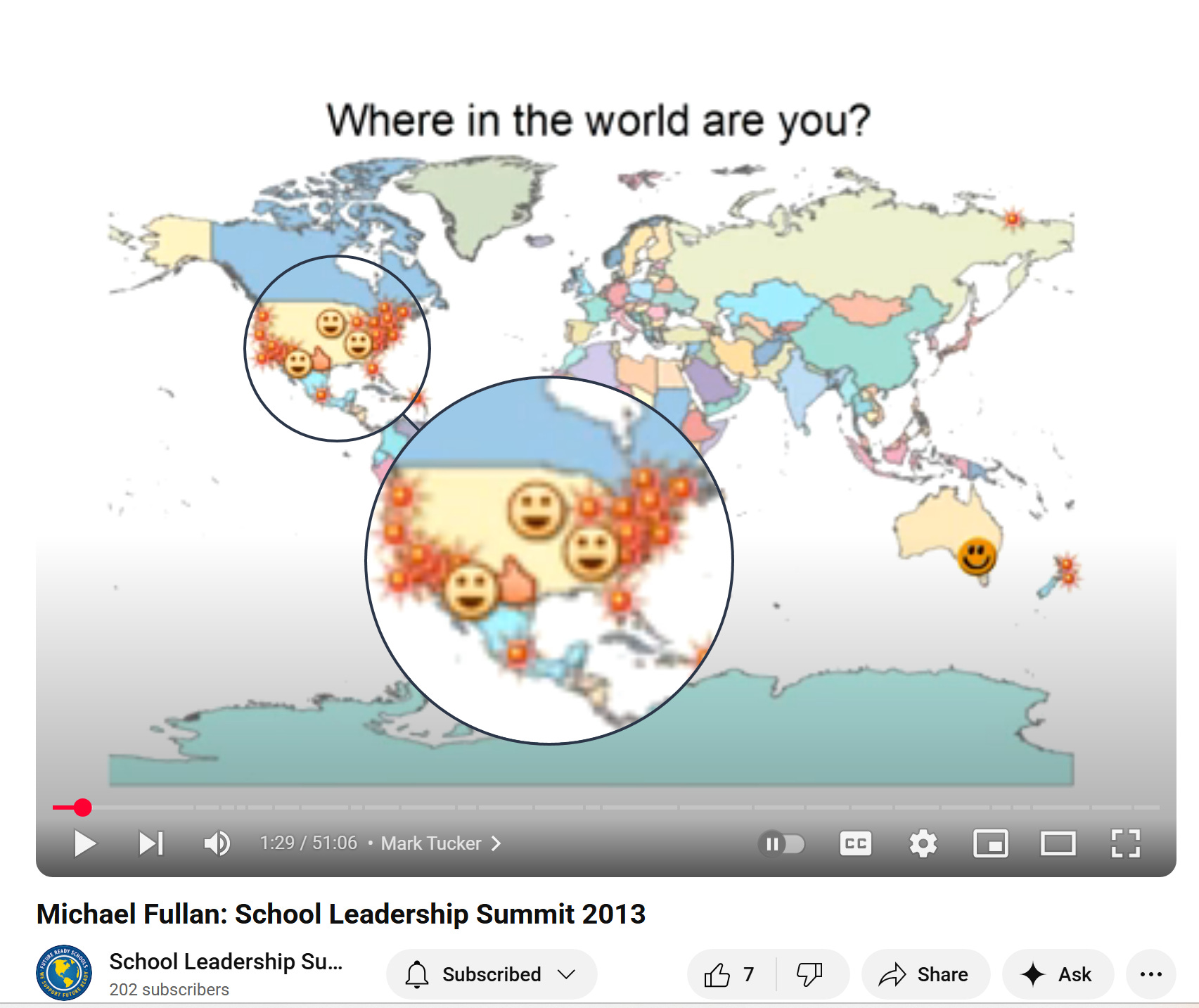
Photo above: Michael Fullan’s NPDL system has been adopted around the globe. This is from a training 2013. The stars and emojis represent school administrators. The system has grown exponentially since 2013.
Parents may have noticed piecemeal changes in schools – a new diversity training here, a social-emotional survey there – without realizing these are pieces of a much larger shift. In reality, many school systems are rolling out an all-encompassing educational framework that goes far beyond academics. A key element of this transformation is what we might call emotional engineering: the deliberate shaping of students’ feelings, mindsets, and behaviors as part of the learning process. Teachers are now expected not only to teach reading or math, but also to cultivate certain emotions and values in children. For example, educators intentionally create classroom norms of belonging where “every voice matters,” actively modeling empathy and listening to student interests so that learners feel safe and valued. This careful construction of a positive emotional climate isn’t accidental – it’s designed to influence how students relate to others and view themselves.
Why are schools so focused on students’ emotions? Advocates of the new framework believe that nurturing social-emotional traits is essential for students to thrive and for society to improve. The thinking is that academic skills alone aren’t enough; schools must also shape children’s character, empathy, resilience, and sense of responsibility. In practice, this means concepts from Social-Emotional Learning (SEL) are no longer confined to a weekly lesson – they are being embedded across the curriculum. One architect of the framework noted that while standalone SEL programs have “supplemented academic learning, they have not been integrated as learning for life,” arguing that all of these skills must work together throughout a child’s education. In short, the emotional and social development of students is becoming a constant, intentional focus in everyday teaching rather than a side initiative.
This emotional engineering often appeals to students’ innate desires to feel purposeful and connected. Teachers are encouraged to frame learning around real-world problems and social causes as a way to engage students’ passions. The results can be powerful: by one account, “nearly all students are attracted” when their learning is presented as an opportunity to “engage the world [and] change the world,” and even previously disengaged students respond strongly to the “passion of the deep-learning” approach. In other words, schools are tapping into kids’ emotions – their empathy, idealism, and even anxiety about global issues – to motivate them in class. On the surface, this can lead to highly engaged learners. But parents should understand that this is a form of psychological conditioning. The school is intentionally guiding not just what your child knows, but how your child feels and reacts to the world. It’s a coordinated effort to produce certain attitudes and mindsets in students, using positive language like “well-being” and “belonging” to describe what is, at its core, a grand experiment in behavior shaping.
The Six Global Competencies (6 C’s) and Reimagined “Civics” Education
Driving this educational overhaul is a set of six core skills and dispositions known as the 6 C’s, or Six Global Competencies. These six competencies – Character, Citizenship, Collaboration, Communication, Creativity, and Critical Thinking – now define what it means to be a successful student in the modern vision of education.
These six competencies sound admirable – who wouldn’t want a child who is resilient, collaborative, and a critical thinker? But it’s important to recognize how different this is from the traditional school focus on content knowledge. The 6 C’s represent a broader agenda for education. Producing good global citizens in the new purpose of education.
The official descriptions (the description parents don’t see) of these competencies explicitly reference things like global issues, human equity, intercultural empathy, and “advancing humanity.” For instance, the Citizenship competency is defined by one global education network as including a “commitment to human equity and well-being through empathy and compassion for diverse values and world views,” and an interest in solving complex problems to benefit society. In other words, being a good student now means developing into a certain type of person with a specific set of global values.
Language matters here. The terms used – character, citizenship, communication – are positive and familiar, but their meanings have been quietly reshaped. Traditional civics class might have taught a student how a bill becomes a law; the new Citizenship aims to shape the student into an activist for global causes. “Character” education isn’t just about personal morality or responsibility; it’s about embracing qualities like empathy and resilience in order to drive social change. Even “Communication” now involves asserting one’s identity and influencing others for impact. These buzzwords can mask the shift from imparting knowledge to instilling a whole worldview and skillset.
While parents are busy opposing one policy or another, the underlying vision guiding many reforms is this unified set of global competencies.
The 6 C’s framework is sometimes dubbed “global competencies” because it’s part of a worldwide push – across many countries and school systems – to redefine the goals of education for the 21st century. While parents are busy opposing one policy or another, the underlying vision guiding many reforms is this unified set of global competencies. It’s a vision that sounds inspiring on paper (who doesn’t want inclusive, creative, critical thinkers?), but it brings along a comprehensive agenda that many parents have never heard fully explained.
New Assessments, Data Tracking, and the “Progression” Experiment
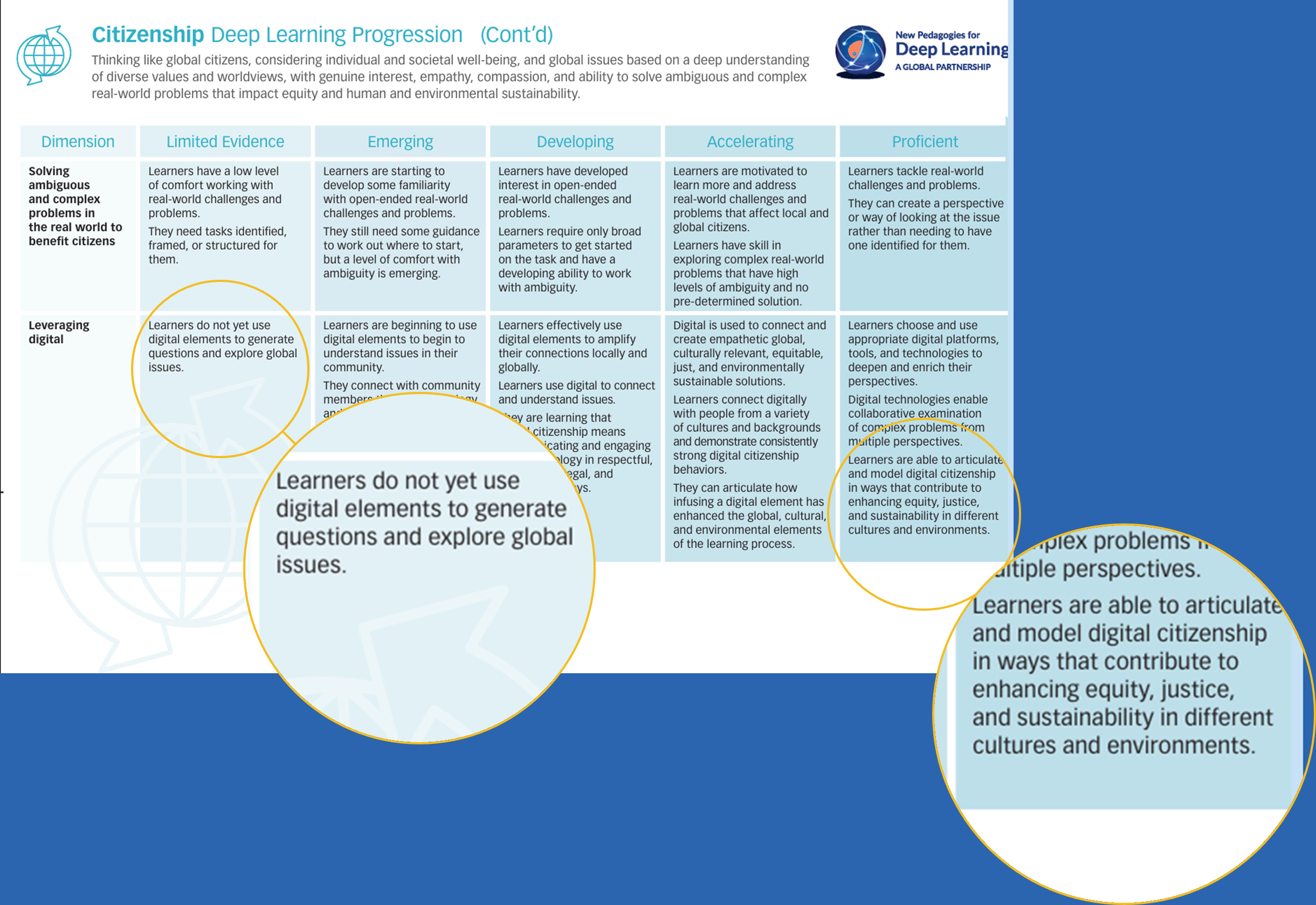
Above is a partial progression chart where teachers keep track of mind shift process
Shifting the goals of education is only part of the story – schools are also changing how they assess and develop these new competencies in students. You might wonder: how do teachers measure something as fuzzy as “character” or “citizenship”? The answer is through detailed assessment rubrics and learning progressions. For each of the 6 C’s, education “experts” have created a continuum of descriptors that map out what a student’s skills and behaviors look like at various levels, from beginner ( free thinker) to advanced ( fully indoctrinated). In other words, there is a progression chart for qualities like collaboration or critical thinking. Teachers use these progression rubrics to pinpoint where each student currently stands and to identify concrete next steps to help the student grow further.
In training material, Michael Fullan’s New Pedagogies for Deep Learning (NPDL) framework explain that these tools “provide a description of the dimensions for each of the 6 C’s and possible pathways for student progress.” Educators can assess a child’s strengths and needs, then design learning activities to address those needs, monitor the student’s progress, and evaluate their development over time.
For example, a Collaboration progression might have several sub-dimensions like “Working interdependently as a team” and “Interpersonal and team-related skills.” At the lowest level (“Limited Evidence”), a student might work alongside peers but not truly together, and struggle with empathy or sharing responsibility. At higher levels, students begin to take on joint decision-making, listen to each other, and eventually demonstrate “a highly effective and synergistic approach to working interdependently” where they leverage each member’s strengths and viewpoints. Teachers observe students during group work and use the rubric to assess which description best fits the student’s current behavior. This isn’t a one-time grade – it’s a continuous tracking system. Regularly, students are assessed on these competencies (often through projects, class activities, reflections, or even peer and self-assessments) to see if they are moving upward on the progression scale. In fact, schools using this framework report that the “student-friendly rubrics” are used frequently by teachers, peers, and the students themselves to gauge growth. Children are even taught the language of the 6 C’s so they can self-reflect: e.g. “I used to give up easily, but now I show grit and don’t quit when work is challenging.” The idea is to make students active participants in their own behavior modification, constantly aware of where they stand and what they need to do to improve in these character and skill domains.
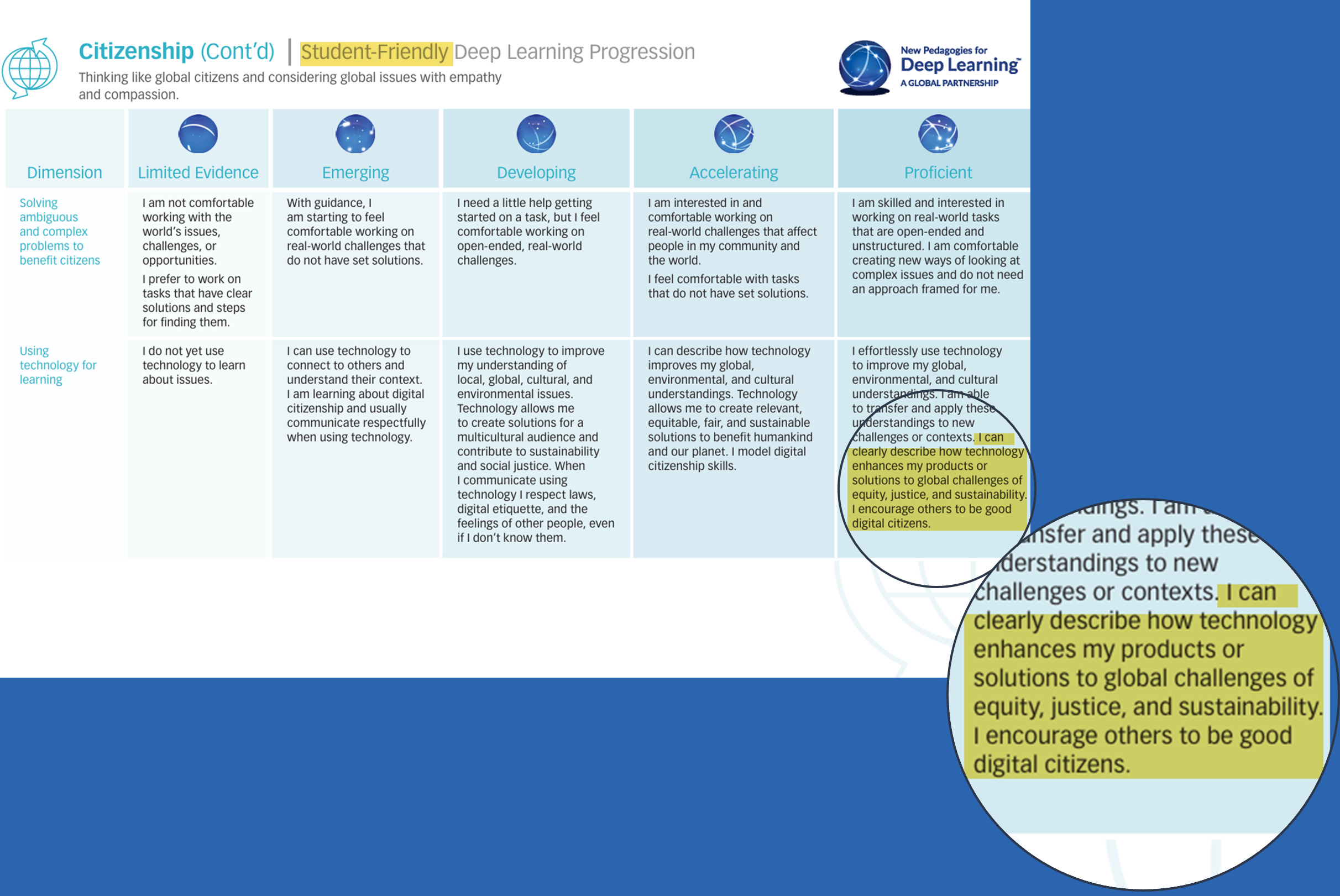
All of this generates a new kind of data on students. Instead of just test scores in math or reading, teachers (and potentially schools and districts) now collect information on each child’s progress in collaboration, creativity, etc. There is even a “Suite of Tools” – essentially software and surveys – designed as an “evaluative monitoring system” to track students’ starting levels and growth in the deep learning competencies. This system allows educators and leaders to monitor progress at all levels, from the individual student up to the whole district or beyond, and to see how well the new approach is working.
In plain terms, the framework comes with an apparatus to measure and tweak the deep learning experiment as it unfolds. If data shows, for instance, that students in a school are weak in Creativity, the teachers might adjust their lessons or bring in new projects to stimulate that area. Likewise, if a particular student isn’t progressing in Collaboration, the teacher can try different group strategies or even explicitly coach the student on teamwork skills. This is a continuous improvement loop: assess -> intervene -> assess again. It resembles a form of social experimentation, using students as the subjects. The architects (Michael Fullan & NPDL) of the system encourage teachers to reflect and iterate in this way, rather than stick to a static curriculum.
They are essentially “tweaking” the educational methods to move each student up the progression chart for each competency. Over years of schooling, a detailed profile can be built of your child’s dispositions – how empathetic they are, how they handle teamwork, how they think about global issues – and the school’s goal is to systematically advance all of those according to the predefined model.
It’s important to note how coordinated and intentional this process is. We’re not talking about a vague idea of teachers being more sensitive to students’ feelings – we’re looking at a full-fledged framework with specific competencies, specific measurement rubrics, and specific pedagogical tactics to shape kids in a desired way. And it is explicitly experimental. In fact, the lead designers, Fullan & NPDL, openly describe it as a means to transform society. One education change leader candidly wrote that “we need education to help us create a new social order” and that this deep-learning model should “become the evolutionary force we so badly need” in the world. Another paper calls for “mobilization of young learners en masse across the globe” – students everywhere steeped in these 6 C’s – in order to “benefit each other and the universe as a whole” and achieve “the unity of the human race”. These are ambitious, even startling admissions. They reveal that this isn’t just about improving test scores or helping Johnny be nicer – it’s a deliberate social re-engineering project through the vehicle of education.
For parents, the takeaway is profound. Many of parents have been in the dark, noticing only isolated issues (a concerning textbook here, a new equity policy there) without realizing they are part of a much grander design. This all-encompassing framework of emotional conditioning, global competencies, and constant assessment changes the role of schooling. Education is no longer just about imparting knowledge; it’s about molding a certain type of person. Whether one agrees with the ideological goals or not, it’s crucial to understand that our children are being shaped by a coordinated system – one that experiments on their social and emotional development, tracks it, and adjusts continuously with the intent of producing adults who fit a specific global ideal.
As a parent, grandparent and a former school counselor, I am all in for exposing the truth. We owe it to ourselves to fully understand this transformation. Only then can we engage in informed conversations about our children’s education, rather than fighting one small fire at a time.
Next post - How we can win the war on ideology. When you understand the system you can break it!